
🧠 AI Engineering Lessons from Building a Local LLM App (Part 5)
Sun Jan 18 2026
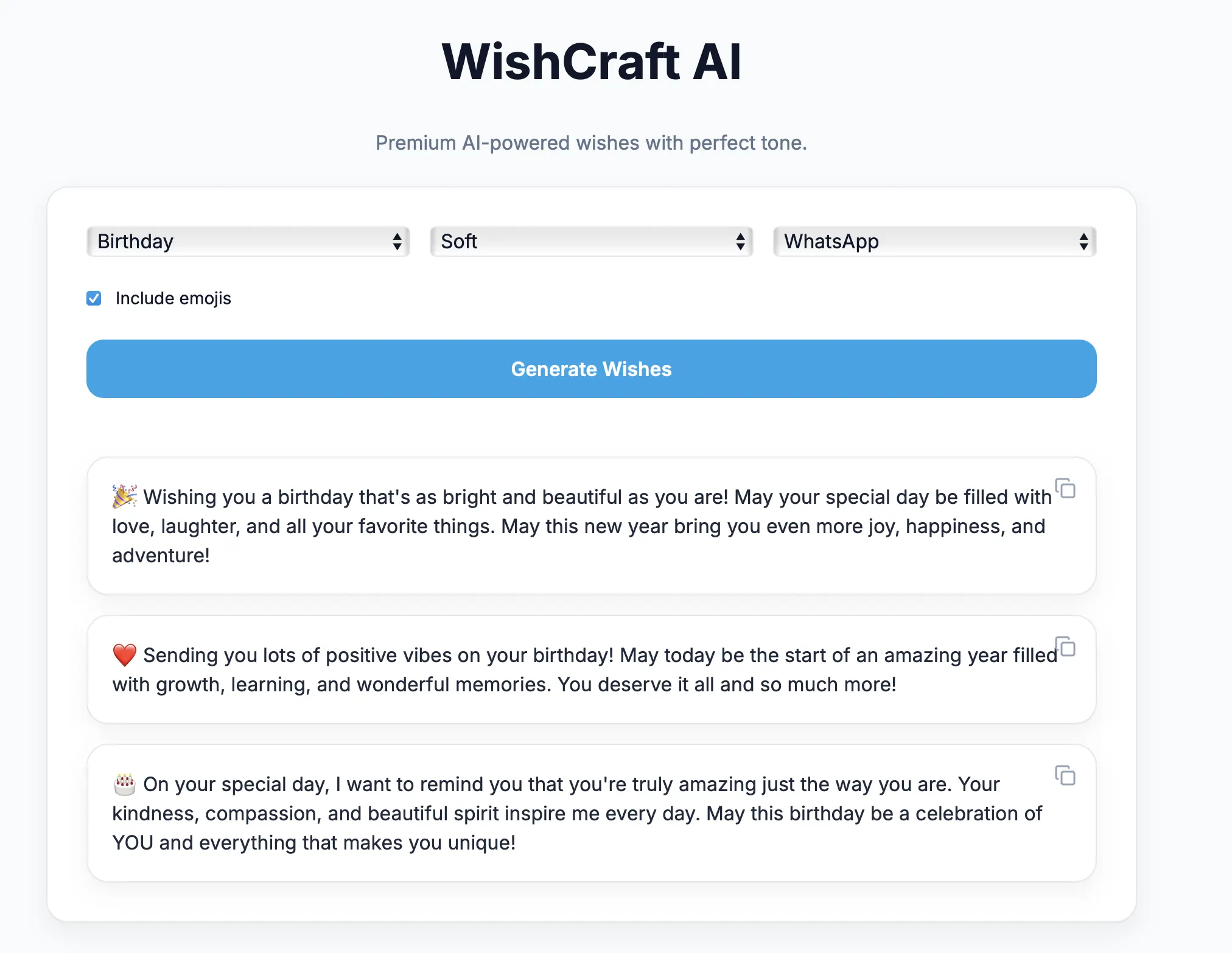
What Really Matters When Building Production-Ready AI Applications
🧩 Series Recap
This marks the final post in our 5-part journey of building a local LLM–powered AI Wish Generator.
Let’s quickly recap what we built:
- Part 1: Architecture & local LLM fundamentals
- Part 2: Backend development & prompt engineering
- Part 3: Modern Next.js frontend & UX design
- Part 4: Dockerization, Ollama & macOS challenges
- Part 5: AI Engineering Lessons from Building a Local LLM App
This post ties everything together.
🎯 Objective of the Final Part
In this article we will discuss:
- Real challenges faced while building the app
- Why LLM apps behave unpredictably
- Techniques to stabilize AI output
- Performance tuning strategies
- Streaming vs blocking responses
- When prompts fail and how to fix them
- When to introduce RAG
- Key AI engineering lessons
This is the difference between demo apps and production AI systems.
⚠️ Common Challenges in AI Application Development
Unlike traditional software, AI systems introduce non-determinism.
Even with the same input:
- Output wording changes
- Length varies
- Emojis behave inconsistently
- Tone may drift
This unpredictability is the core challenge of AI engineering.
🧠 Challenge 1: Unstable Output Format
Without strict rules, LLMs may:
- Ignore line breaks
- Merge multiple wishes
- Add explanations
- Change numbering styles
❌ Weak prompt
Write 3 birthday wishes.
✅ Stable prompt
Generate exactly 3 wishes.
Each must be multi-line.
Separate with a blank line.
Do not add headings.
Lesson: Prompt structure matters more than creativity.
🎭 Challenge 2: Emoji & Platform Drift
LLMs naturally mix emoji styles:
:tada: 🎉 ✨
This breaks platform realism.
Solution
- Explicit platform emoji rules
- Never allow mixed formats
- Limit emojis per line
This transformed output quality instantly.
🧠 Challenge 3: Emotional Sensitivity
Condolence messages are dangerous if mishandled.
Problems include:
- Overly cheerful tone
- Inappropriate emojis
- Generic phrases
Guardrails added
- Emojis disabled by default
- Softer language rules
- Shorter sentence limits
AI systems must respect emotional context.
⚡ Challenge 4: Latency Perception
Local LLM inference can take:
- 5–10 seconds on CPU
Users perceive this as slowness.
Even when technically acceptable, UX suffers.
🌊 Streaming vs Blocking Responses
Blocking (traditional)
User clicks generate
Wait 8 seconds
Response appears
Feels slow.
Streaming (recommended)
User clicks generate
Text appears immediately
Tokens stream live
Feels intelligent and fast.
Streaming improves perceived performance by 60–70%.
🧠 Streaming Architecture
Ollama (tokens)
   ↓
FastAPI StreamingResponse
   ↓
Next.js incremental render
This is how ChatGPT works internally.
⚙️ Performance Optimization Techniques
Backend
- Use smaller models when possible
- Limit max tokens
- Use temperature 0.6–0.8
- Cache static prompts
Frontend
- Disable UI while generating
- Show loading indicators
- Animate text appearance
Perception matters more than raw speed.
🧩 When Prompt Engineering Is Not Enough
Prompts alone fail when:
- User data is personalized
- Context exceeds token limit
- Knowledge must be factual
- Responses must reference documents
This is where RAG becomes necessary.
📚 When to Introduce RAG
Use Retrieval-Augmented Generation if:
- You need memory
- You use documents
- You need factual grounding
- You require traceability
Do not use RAG for:
- Greetings
- Creative writing
- Generic content
Prompt-only systems are faster and simpler.
🧠 Key Engineering Insight
Most AI apps do not fail because of the model.
They fail because of:
- Poor prompt governance
- Weak UX feedback
- No guardrails
- Unstable formatting
- Lack of streaming
AI engineering is system engineering.
🏗️ Production Checklist
Before shipping an AI app:
- ✅ Deterministic prompt structure
- ✅ Platform formatting rules
- ✅ Input validation
- ✅ Timeout handling
- ✅ Streaming support
- ✅ Clear UX feedback
- ✅ Containerized runtime
- ✅ Linux-based deployment
🧠 What This Project Teaches
By building this app you learned:
- Local LLM orchestration
- Prompt engineering patterns
- Frontend AI UX design
- Containerization of LLM runtimes
- macOS vs Linux realities
- Cloud deployment mindset
These skills directly translate to:
- AI copilots
- Enterprise chatbots
- Knowledge agents
- Workflow automation
- RAG systems
🚀 From Demo App to AI Engineer
If you can:
- Control LLM behavior
- Enforce output contracts
- Design stable prompts
- Stream responses
- Deploy locally and in cloud
You are no longer experimenting.
You are engineering AI systems.
🧭 Final Architecture Summary
Next.js UI
   ↓
FastAPI Orchestrator
   ↓
Prompt Intelligence Layer
   ↓
Ollama Runtime
   ↓
Local LLaMA Model
This architecture scales naturally to:
- Agents
- MCP servers
- RAG pipelines
- Tool-using AI
✨ Final Thoughts
AI engineering is not about chasing models.
Models will change.
Frameworks will evolve.
But these fundamentals remain:
- Structured prompts
- Deterministic outputs
- Strong UX
- Clear architecture
- Deployment discipline
Master these — and any model becomes usable.