⚙️ RAG vs Semantic Grounding vs Structured Database Retrieval
Mon Aug 10 2026
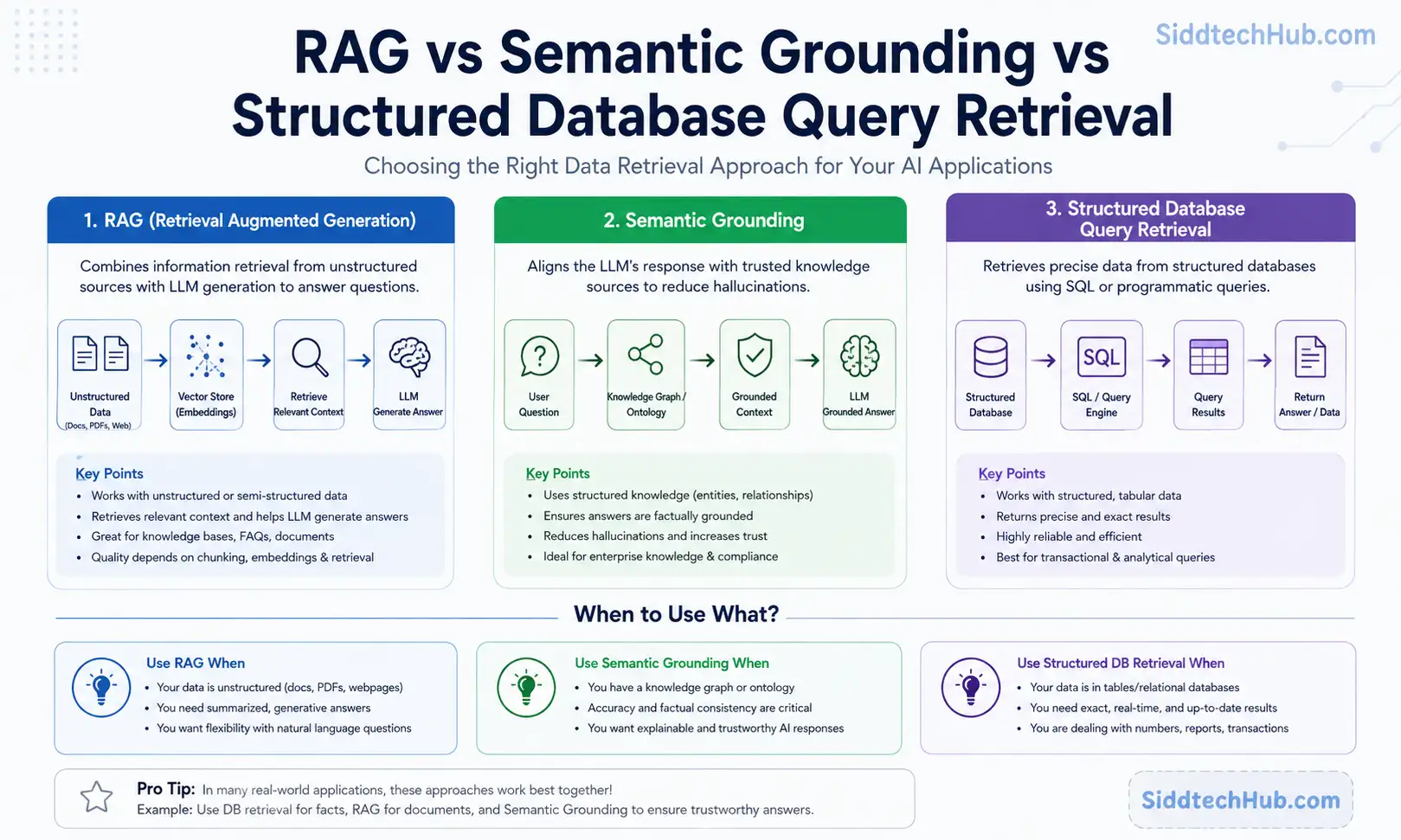
🔥 RAG vs Semantic Grounding vs Database Retrieval: What’s the Difference?
Large Language Models are excellent at understanding and generating natural language.
But there is an important problem:
Where should an AI application get the facts required to answer a user's question?
Should it search documents?
Should it understand relationships between business concepts?
Or should it query a database directly?
This is where three commonly discussed approaches come into the picture:
- Retrieval-Augmented Generation (RAG)
- Semantic Grounding
- Structured Database Query Retrieval
They are related, but they are not the same thing.
Understanding the difference is important when designing reliable enterprise AI applications.
Let's simplify them.
Why Retrieval Matters for LLM Applications
An LLM primarily generates an answer based on:
- its training
- the prompt
- any context provided at runtime
The model does not automatically know:
- your latest company policies
- today's inventory
- a customer's current account balance
- your internal product documentation
- relationships defined inside enterprise systems
If an application needs this information, it must retrieve it from somewhere.
A simple AI application can therefore be thought of as:
User Question
     ↓
Retrieve Relevant Information
     ↓
Provide Context to the LLM
     ↓
Generate Answer
The important question is:
What type of retrieval should we use?
The answer depends mainly on the type of data and the kind of question being asked.
1. Retrieval-Augmented Generation — RAG
RAG stands for Retrieval-Augmented Generation.
The idea is simple:
Retrieve useful information first, then let the LLM generate an answer using that information.
Instead of expecting the model to answer entirely from its training data, the application retrieves relevant content from an external knowledge source.
A Typical RAG Flow
A common RAG architecture looks like this:
Documents
   ↓
Chunking
   ↓
Embeddings
   ↓
Vector Database
   ↓
Semantic Search
   ↓
Relevant Context
   ↓
LLM
   ↓
Answer
Suppose your company has thousands of PDF documents.
A user asks:
What is our policy for carrying unused annual leave?
The RAG system can:
- Convert documents into smaller chunks.
- Create embeddings for those chunks.
- Store the embeddings in a vector database.
- Convert the user's question into an embedding.
- Find semantically similar document chunks.
- Send those chunks to the LLM.
- Generate an answer.
Where RAG Works Best
RAG is particularly useful for unstructured and semi-structured information.
Examples include:
- PDF files
- Word documents
- knowledge-base articles
- support documentation
- technical manuals
- websites
- contracts
- internal policies
For example:
Question:
How do I configure authentication for our API?

Source:
Developer documentation

Best retrieval approach:
RAG
Strengths of RAG
Works well with large document collections
Organizations often have thousands of documents that cannot realistically be placed inside every LLM prompt.
RAG retrieves only the most relevant pieces.
Supports natural-language questions
Users do not need to know where the information lives.
They can simply ask:
What are the prerequisites for deploying our application?
Keeps knowledge outside the LLM
The model itself does not need to be retrained every time a document changes.
You update the knowledge source instead.
Limitations of RAG
RAG is powerful, but retrieval quality matters.
A poor RAG implementation may retrieve:
- irrelevant chunks
- incomplete context
- outdated documents
- semantically similar but incorrect information
The quality of a RAG system depends heavily on:
Chunking Strategy
        +
Embedding Model
        +
Metadata
        +
Retrieval Method
        +
Ranking
        +
Prompt Design
This is why production RAG systems involve much more than simply connecting an LLM to a vector database.
2. Semantic Grounding
Semantic Grounding is a broader concept.
The goal is to ensure that an AI response is connected to trusted meaning, context, entities, and relationships.
A useful way to think about it is:
RAG retrieves relevant information. Semantic grounding helps ensure the AI understands what that information means in the correct context.
Semantic grounding may use RAG, but it is not limited to RAG.
A Simple Example
Imagine a user asks:
What products are associated with Apollo?
The word Apollo could mean many things:
- a project
- a product
- a customer
- a space program
- an internal business initiative
A simple keyword search might struggle.
A semantically grounded system may know:
Apollo
   ↓
Entity Type: Internal Project
   ↓
Owned By: Platform Engineering
   ↓
Related Products:
   ├── Product A
   ├── Product B
   └── Product C
The system now understands the meaning and relationship behind the entity.
What Can Provide Semantic Grounding?
Semantic grounding can come from different sources:
- Knowledge Graphs
- Ontologies
- Metadata
- Entity Relationships
- Business Taxonomies
- Master Data
- Enterprise Knowledge Bases
- Trusted Documents
- Structured APIs
The important concept is not the technology itself.
The important concept is that the model's answer is anchored to trusted contextual knowledge.
Semantic Grounding Flow
A simplified flow might look like this:
User Question
     ↓
Entity / Intent Recognition
     ↓
Trusted Knowledge Model
     ↓
Relationships + Context
     ↓
LLM
     ↓
Grounded Answer
For example:
User:
Who owns Project Falcon?

Knowledge Graph:

Project Falcon
     ↓
Owned By
     ↓
Cloud Engineering
Instead of relying on a probabilistic guess, the AI receives a trusted relationship.
Where Semantic Grounding Works Best
Semantic grounding becomes valuable when:
- terminology has specific business meaning
- relationships between entities matter
- factual consistency is important
- multiple systems describe the same entities
- enterprise knowledge needs to be connected
Some common use cases include:
- healthcare knowledge systems
- financial services
- enterprise search
- compliance systems
- product catalogs
- knowledge graphs
- complex organizational knowledge
RAG vs Semantic Grounding
This is where the distinction becomes important.
RAG is usually a retrieval architecture.
Semantic grounding is more about anchoring AI output to trusted meaning and context.
For example:
RAG:

Question
   ↓
Find Similar Documents
   ↓
LLM
Whereas semantic grounding may look like:
Question
   ↓
Understand Entity + Relationship
   ↓
Retrieve Trusted Context
   ↓
LLM
These approaches can also work together.
A RAG pipeline can itself be part of a larger semantic grounding architecture.
3. Structured Database Query Retrieval
Now consider a completely different question:
What was our total revenue last month?
Would you search for semantically similar PDF paragraphs?
Probably not.
The answer likely exists inside a database.
For example:
SELECT SUM(amount)
FROM orders
WHERE order_date >= '2026-07-01'
  AND order_date < '2026-08-01';
This is Structured Database Query Retrieval.
The application retrieves exact information from structured data sources.
Typical Structured Retrieval Flow
User Question
      ↓
Intent Detection
      ↓
Generate / Select Query
      ↓
SQL Database
      ↓
Query Result
      ↓
LLM
      ↓
Natural Language Answer
Suppose the user asks:
How many orders are currently pending?
The application could execute:
SELECT COUNT(*)
FROM orders
WHERE status = 'PENDING';
The database may return:
143
The LLM can then respond:
There are currently 143 pending orders.
Where Database Retrieval Works Best
Structured database retrieval is ideal for:
- numerical values
- transactions
- reports
- counts
- filters
- aggregations
- real-time operational data
For example:
Question:
How many customers subscribed this week?

Source:
Customer database

Best retrieval approach:
Structured Database Query
Another example:
Question:
Show the five highest-value orders today.

Source:
Orders table

Best retrieval approach:
Structured Database Query
Why Not Use RAG for Everything?
This is an important architectural question.
Imagine storing database rows as embeddings and asking:
What is the exact account balance for customer 10291?
Vector similarity search is probabilistic.
SQL is deterministic.
For exact structured information, a query such as:
SELECT balance
FROM accounts
WHERE customer_id = 10291;
is usually far more appropriate.
Use semantic retrieval when you need similarity. Use structured queries when you need precision.
Side-by-Side Comparison
| Feature | RAG | Semantic Grounding | Structured DB Retrieval |
|---|---|---|---|
| Main Goal | Retrieve useful context for generation | Anchor answers to trusted meaning | Retrieve precise structured data |
| Typical Data | Documents and text | Knowledge models and trusted context | Tables and relational data |
| Retrieval Style | Semantic similarity | Entity/context-aware | Deterministic query |
| Common Technology | Embeddings + Vector DB | Knowledge Graphs, Ontologies, RAG | SQL, APIs, Query Engines |
| Best For | Documents | Relationships and domain meaning | Numbers and transactions |
| Exact Calculations | Limited | Depends on source | Excellent |
| Natural Language | Excellent | Excellent | Usually via Text-to-SQL |
| Typical Result | Context passages | Trusted semantic context | Rows / values |
An Easy Way to Remember the Difference
Imagine you work inside a large company.
You ask three different colleagues three different questions.
RAG — The Librarian
You ask:
"Find the documents that explain our remote-working policy."
The librarian searches through documents and gives you the most relevant pages.
That is similar to RAG.
Semantic Grounding — The Domain Expert
You ask:
"When our company says 'Strategic Account', what exactly does that mean?"
The expert understands company terminology, categories, relationships, and rules.
That is similar to Semantic Grounding.
Structured Database Retrieval — The Analyst
You ask:
"How many strategic accounts generated more than $1M in revenue last quarter?"
The analyst runs a precise database query.
That is Structured Database Query Retrieval.
Choosing the Right Approach
A simple decision tree can help:
What kind of information is required?
              │
              ├── Documents / Text
              │        ↓
              │       RAG
              │
              ├── Business Meaning / Relationships
              │        ↓
              │   Semantic Grounding
              │
              └── Exact Rows / Numbers / Aggregations
                       ↓
                 Database Query
However, real-world applications often require more than one.
The Powerful Approach: Combine Them
Modern AI systems increasingly use hybrid retrieval architectures.
Imagine an enterprise assistant receiving this question:
Which customers are affected by the new premium-support policy?
Answering this may require several steps.
Step 1 — RAG
Retrieve the latest premium-support policy.
Policy Documents
      ↓
Vector Search
      ↓
Relevant Policy Sections
Step 2 — Semantic Grounding
Determine what the organization means by:
Premium Customer
Support Tier
Enterprise Account
These concepts may come from an enterprise ontology or knowledge graph.
Step 3 — Structured Database Query
Query the customer database.
SELECT customer_id, company_name
FROM customers
WHERE support_tier = 'PREMIUM';
Step 4 — LLM
Combine the information into a useful response.
The architecture might look like this:
                    User Question
                          ↓
                    AI Orchestrator
                          │
          ┌───────────────┼────────────────┐
          │               │                │
          ↓               ↓                ↓
      RAG Search     Semantic Layer    SQL Database
          │               │                │
          ↓               ↓                ↓
     Documents        Entities &        Exact Data
                     Relationships
          │               │                │
          └───────────────┼────────────────┘
                          ↓
                         LLM
                          ↓
                   Grounded Answer
This is much closer to how sophisticated enterprise AI applications are designed.
A Simple Python Example
The following example demonstrates the basic idea of routing different questions to different retrieval systems.
def classify_query(question: str) -> str:
    question = question.lower()

    database_keywords = [
        "how many",
        "total",
        "revenue",
        "sales",
        "count",
        "average",
    ]

    document_keywords = [
        "policy",
        "document",
        "manual",
        "guide",
        "procedure",
    ]

    if any(keyword in question for keyword in database_keywords):
        return "database"

    if any(keyword in question for keyword in document_keywords):
        return "rag"

    return "semantic_grounding"
We can then route the query:
def answer_question(question: str):
    retrieval_type = classify_query(question)

    if retrieval_type == "database":
        context = query_database(question)

    elif retrieval_type == "rag":
        context = search_vector_database(question)

    else:
        context = search_semantic_knowledge(question)

    return generate_llm_answer(
        question=question,
        context=context,
    )
The helper functions could represent completely different systems:
def query_database(question):
    return {
        "total_sales": 152340
    }


def search_vector_database(question):
    return [
        "Relevant document chunk 1",
        "Relevant document chunk 2",
    ]


def search_semantic_knowledge(question):
    return {
        "entity": "Project Apollo",
        "owner": "Platform Engineering",
        "status": "Active",
    }


def generate_llm_answer(question, context):
    return f"""
Question:
{question}

Retrieved Context:
{context}

Generate an answer using only the supplied context.
"""
Now different questions naturally use different retrieval paths:
print(
    answer_question(
        "What is our employee leave policy?"
    )
)

print(
    answer_question(
        "What were total sales this month?"
    )
)

print(
    answer_question(
        "Who owns Project Apollo?"
    )
)
This example is intentionally simple.
In a real application, query routing may itself be performed by:
- an LLM
- a classifier
- an agent
- deterministic rules
- a combination of these techniques
What About Semantic Search?
Another point that often causes confusion is the difference between semantic search and semantic grounding.
They are not the same.
Semantic search typically means:
Question
   ↓
Embedding
   ↓
Vector Similarity
   ↓
Relevant Content
Its job is to find content that is similar in meaning.
Semantic grounding is broader.
It asks:
What trusted knowledge should the model use so that its response reflects the correct meaning and context?
Semantic search can therefore be one component of a grounding system.
What About Text-to-SQL?
LLMs can also convert natural-language questions into SQL.
For example:
User:

What were the top five products by revenue last month?
An LLM could generate:
SELECT
    product_name,
    SUM(revenue) AS total_revenue
FROM sales
WHERE sale_date >= '2026-07-01'
  AND sale_date < '2026-08-01'
GROUP BY product_name
ORDER BY total_revenue DESC
LIMIT 5;
The database executes the query and returns the result.
This provides a powerful interface:
Natural Language
      ↓
LLM
      ↓
SQL
      ↓
Database
      ↓
Result
      ↓
LLM Explanation
However, production Text-to-SQL systems should include strong safeguards.
For example:
- read-only database permissions
- schema restrictions
- SQL validation
- query timeouts
- row limits
- user-level authorization
Allowing an LLM unrestricted database access is generally a bad design.
Which Approach Should You Choose?
Here is a simple rule of thumb.
Choose RAG when
Your source data looks like:
PDFs
Word Documents
Web Pages
Technical Documentation
Policies
Knowledge Articles
And your users ask questions such as:
Explain our refund policy.
Choose Semantic Grounding when
Your domain contains:
Entities
Relationships
Business Terminology
Ontologies
Taxonomies
Knowledge Graphs
Trusted Context
And your application needs to understand questions such as:
Which products belong to our enterprise security portfolio?
Choose Structured Database Retrieval when
Your data looks like:
Customers
Orders
Invoices
Transactions
Products
Metrics
Financial Records
And users ask:
What was the total revenue yesterday?
One Question Can Require All Three
Consider:
Why did enterprise support costs increase last quarter?
The answer may require several retrieval methods.
Structured Database Retrieval
Calculate support costs:
SELECT
    quarter,
    SUM(cost)
FROM support_transactions
GROUP BY quarter;
RAG
Retrieve support-policy documents and operational reports.
Semantic Grounding
Understand relationships such as:
Enterprise Customer
      ↓
Support Tier
      ↓
Dedicated Engineer
      ↓
Higher Support Cost
The LLM can then combine all these sources into a useful explanation.
This is why retrieval architecture is becoming such an important part of modern AI Engineering.
The Bigger Picture
The evolution of enterprise AI is moving beyond:
User
 ↓
LLM
 ↓
Answer
Toward architectures that look more like:
                   User
                    ↓
              AI Orchestrator
                    ↓
       ┌────────────┼─────────────┐
       ↓            ↓             ↓
   Vector DB    Knowledge      SQL / APIs
                  Graph
       ↓            ↓             ↓
       └────────────┼─────────────┘
                    ↓
                   LLM
                    ↓
             Grounded Answer
The LLM becomes the reasoning and language layer, while enterprise systems remain the source of truth.
That distinction is important.
Key Takeaways
If you remember only a few things from this article, remember these:
RAG
Search relevant content and give it to the LLM.
Best suited for documents and unstructured knowledge.
Semantic Grounding
Anchor the model to trusted meaning, relationships, and context.
Best suited for domain knowledge and enterprise semantics.
Structured Database Query Retrieval
Ask structured systems for exact data.
Best suited for transactions, metrics, calculations, and operational information.
And most importantly:
You do not always need to choose only one.
The most capable AI applications increasingly combine all three:
RAG
+
Semantic Grounding
+
Structured Retrieval
+
LLM
=
Reliable Enterprise AI
Final Thoughts
RAG became popular because it solved an important problem: giving LLMs access to external knowledge.
But as AI systems mature, retrieval is becoming more sophisticated.
Not every question should be answered using a vector database.
Not every question should become a SQL query.
And not every problem can be solved purely by retrieving similar text.
A strong AI architecture understands what kind of knowledge is required and chooses the appropriate source.
For beginners, a useful mental model is:
Need relevant documents?
        → RAG

Need trusted meaning and relationships?
        → Semantic Grounding

Need exact numbers or records?
        → Structured Database Query

Need all of them?
        → Build a hybrid retrieval architecture
That is where modern AI engineering becomes much more interesting. 🚀